notizie a breve… torno domani per votare…
poi…
see ya 🙂

notizie a breve… torno domani per votare…
poi…
see ya 🙂
su 20385 messaggi smistati _oggi_ da uno dei server di posta che ho in gestione, il 97% sono stati di posta indesiderata (e lo stesso andamento pare averlo avuto per tutta la settimana e quelle precedenti…)
nelle prime ore della mattina, le 2 cpu sono rimaste fisse al 100% di carico per smistare lo schifo che arrivava come un’inesorabile mareggiata dalle ore notturne…
ma quanti soldi stiamo sbattendo via per tutto il sistema di posta internazionale che h24 si ciccia tutto sto schifo????? è tempo macchina buttato nel cesso… (e quindi corrente elettrica, personale addetto, edifici, strutture di logistica…)
non ho parole…
p.s. qualche altro sistemista ha dei numeri su cui possiamo fare un po di confronti?
avrei considerazioni da fare in merito… ma
meglio di no 😉
p.s. almeno filp4mac poteva compralo…
do not ever try to bet on something extremely stupid with an engineer… he’ll do it
   The IP datagram is printed, on a small scroll of paper, in
   hexadecimal, with each octet separated by whitestuff and blackstuff.
   The scroll of paper is wrapped around one leg of the avian carrier.
   A band of duct tape is used to secure the datagram's edges.  The
   bandwidth is limited to the leg length.  The MTU is variable, and
   paradoxically, generally increases with increased carrier age.  A
   typical MTU is 256 milligrams.  Some datagram padding may be needed.

   Upon receipt, the duct tape is removed and the paper copy of the
   datagram is optically scanned into a electronically transmittable
   form.
taken from: http://www.blug.linux.no/rfc1149/
probably most of you already know that RFC 😀
yes!
with the OmniKEY card reader that some developers gave me as present at FOSDEM, now i can access my FSFE smartcard
 [/]#  gpg --card-status

Application ID ...: D2760001240101010001000002DF0000
Version ..........: 1.1
Manufacturer .....: PPC Card Systems
Serial number ....: 000002DF
Name of cardholder: Guido Serra aka Zeph
Language prefs ...: de
Sex ..............: male
URL of public key : [not set]
Login data .......: zeph
Private DO 1 .....: [not set]
Private DO 2 .....: [546] Guido Serra
CA fingerprint 1 .: C485 A6CD 7EC6 6E9E EC33  65F2 70F2 75E4 C32F 6CA5
Signature PIN ....: forced
Max. PIN lengths .: 254 254 254
PIN retry counter : 3 3 3
Signature counter : 0
Signature key ....: [none]
Encryption key....: [none]
Authentication key: [none]
General key info..: [none]
now… what’s best? i have this card with it’s own fingerprint… than i had the old gserra@guidoserra.it and the new zeph@gnudd.com … both signed by a lot of people during the DEFCON… someone told me to create a subkey of gserra@guidoserra.it and intall it on the smartcard… but… don’t know
suggests are welcome…
PATCH + + + [ gnupg-ccid-udev_omnikey-usb.taz ]
Choose the Debian release or press CTRL+C to abort:
[ hamm, slink, potato, woody, sarge, etch, lenny, sid ]
> sid
I: Retrieving Release
I: Retrieving Packages
I: Validating Packages
I: Resolving dependencies of required packages...
I: Resolving dependencies of base packages...
I: Found additional base dependencies: dhcp3-server libldap-2.4-2
I: Checking component main on http://ftp.debian.org/debian...
I: Retrieving adduser
I: Validating adduser
I dedicated a server for generating and executing Debian UML virtual machines… I can develop whatever i want on every release of Debian… without waste time inserting CD s or lock a single hw machine for the development period i need that particular combination of distro/release/toolchain. I love that stuff. 😀
Microsoft in Ambrosiana, con OoXML
bah… come sbattere via soldi pubblici… oramai da 4 anni la
Biblioteca Sormani (la biblioteca centrale del Comune di Milano) ha
tutto il fondo Stendhaliano / Bucci, online grazie a PHP + MySQL +
Apache con un software GPL realizzato custom da me…
avrebbero potuto riusarlo, gratis… no comment
http://www.digitami.it/stendhal/
http://www.digitami.it/stendhal/partecipanti.htm
p.s. prima che qualcuno rompa e balle… il viewer delle scansioni è gratuito/libero e pacchettizzato Debian… 😉
apt-get install djvulibre-plugin
p.s.(2) su firefox / linux, ha un problema di visualizzazione, mai risolto… per recuperare un’immagine e vederla fate:
wget -c ‘djvu.php?n_catalogo=22&postilla=front&to=file’
(il pezzo iniziale del path è http://www.digitami.it/stendhal/ricerca/, l’ho rimosso per permettervi di vedere la stringa)
e apritela con djview4
…l’immagine viene caricata a blocchi via web da un webserver non accessibile da internet, e passata poco per volta dal codice php dalla macchina interna a internet… su explorer e firefox per windows funziona… su linux no, chi sa risolvere l’arcano dilemma?
107 	 case "file":
108 	   $fp = fopen($file,"r");
109 	   if ($fp === false) die("errore nell'apertura del file");
110
111 	   Header("Content-Type: image/x.djvu");
112 	   Header("Content-Disposition: attachment; filename=$file_name");
113 	   fpassthru($fp);
114
115 	   fclose($fp);
116 	   break;
p.s. (3) DISCLAIMER per i lameri… il codice non è perfetto, ma directory traversal e SQL injection state tranquilli che non vanno, e cmq l’utenza usata non ha permessi di scrittura sul DB
a friend (thanks Fernando!) has just sent me an email with this photo:
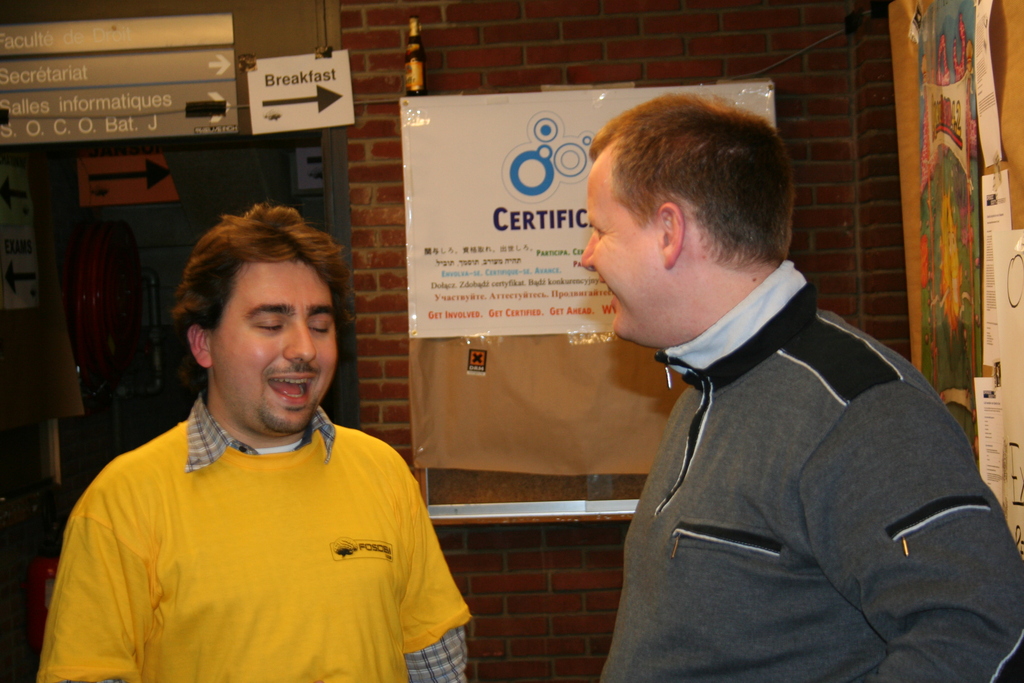
(original: http://www.flickr.com/photos/jriddell/2291486365/)
it’s me discussing with the community manager of Trolltech 😉

fanculo a tutto e a tutti… domani me ne vado al FOSDEM a Bruxelles
(è da una settimana che sono rinchiuso in casa a lavorare per via dell’influenza)
porto dietro il portatile e lavoro da la
ci si rivede lunedi’ mattina in Italia
*** chi ha bisogno mi trova sul cellulare privato o via email ***
ebbene si… non facciamo solo muri 😉
(17:55:37) LiViO: te ne intendi di MACINTOSH?
(17:55:39) LiViO: 😛
(17:55:44) Zeph: che laur l’e’?
(17:55:55) LiViO: en laur griss
(17:56:04) Zeph: gho chel neger
(17:56:07) Zeph: ho mia me
(17:56:13) LiViO: no figa, l’è mia stess
(17:56:16) Zeph: eh
(17:56:18) Zeph: disie me
 Guido Maria Serra